
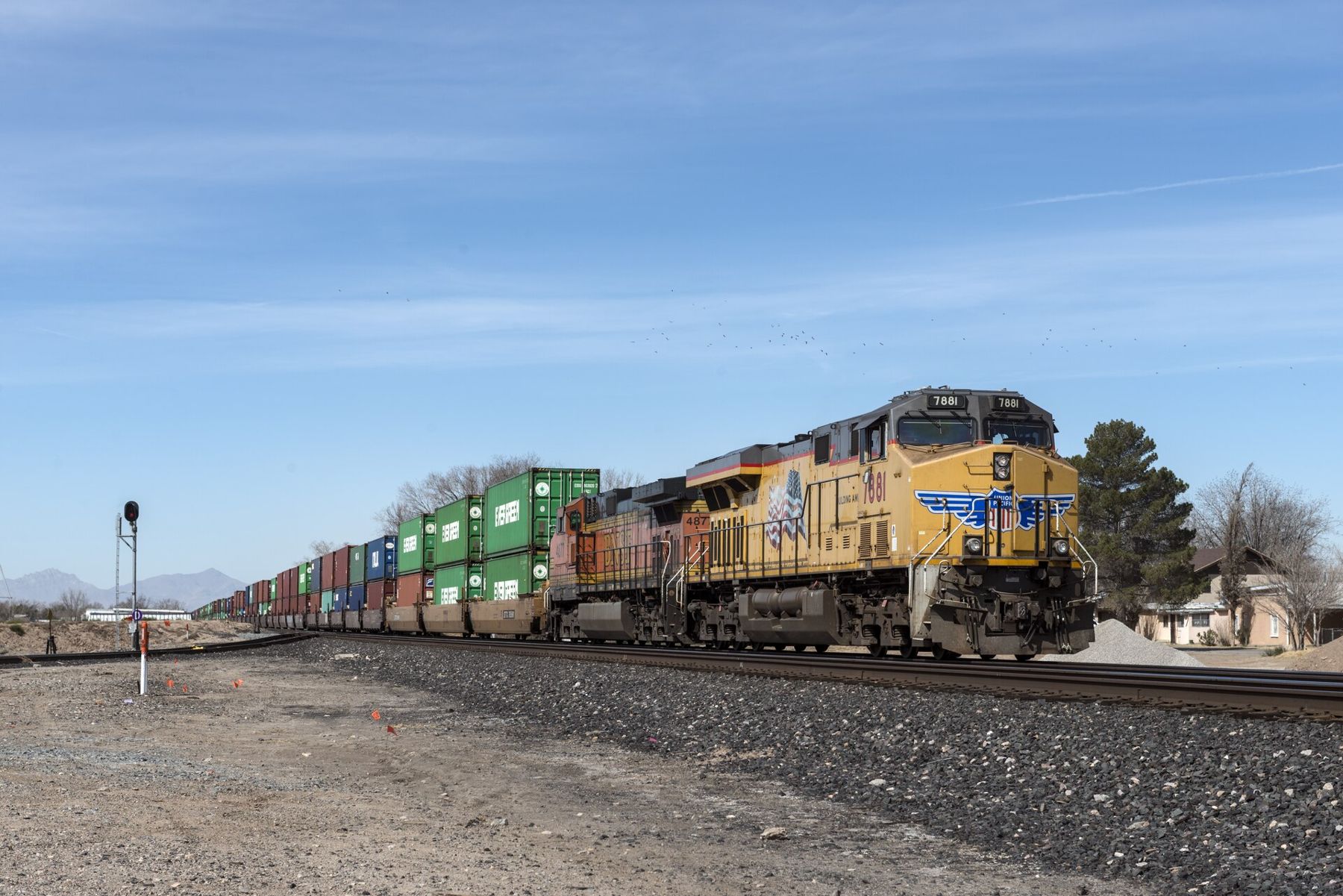
Desert senseWatch trains only from public roads and never from the tracks or right of way. Crossings without gates are common, and freights are faster and quieter than they look.
Stand near the tracks in Van Horn for a while and a train will come. Long freights roll through day and night, stacked with containers or loaded with grain and machinery, their engines labouring up the long grades or running easy down them. They follow a route laid out across the desert more than a century ago, and without that line there would be no town here at all.
Racing west across the desert
In the years after the Civil War, the country wanted a southern railroad to the Pacific. The Texas and Pacific Railway was chartered for that purpose and built west from the settled part of the state, across the plains and the Pecos country toward El Paso. At the same time, the Southern Pacific was building east from California, across Arizona and New Mexico, aiming at the same corridor.
The two lines met near Sierra Blanca, in what is now Hudspeth County, in the early 1880s. Rather than lay two railroads side by side to El Paso, they agreed to share the Southern Pacific's track for the last stretch west. The meeting tied far West Texas to the rest of the country by rail, and the country between the Pecos and the Rio Grande changed for good.
Building across this land was hard work. Crews laid track across alkali flats and rocky basins under a fierce sun, with little shade and no local timber. Ties, rail and almost all supplies came in by train behind the construction itself. Water was the biggest problem, and it shaped what came next.
Water stops and section towns
Steam locomotives needed water, and lots of it, at regular intervals. Across a desert with few springs and no rivers, the railroad had to find wells and dig tanks every so often to keep its engines running. Around those wells grew stations, and around the stations grew towns.
Van Horn began this way. The water there, near wells long used by travellers on the old trails, made it a useful stop, and the town grew around the depot and the tracks. Other places along the line began the same way as section towns, where crews lived to maintain a stretch of track, often in a few company houses, with a water tank and a siding. Some grew into small towns. Many shrank to a name on a sign or disappeared when diesels replaced steam and the railroad no longer needed men every few miles.
The line brought cattle and later goods out of the region, and people, mail and supplies in. Ranching spread across the basins once cattle could reach markets by rail, and Van Horn became the seat of Culberson County when the county was organised in the early twentieth century. Later the highways followed the same corridor, and today I-10 runs beside the tracks for long stretches, as our story on the old highways tells.
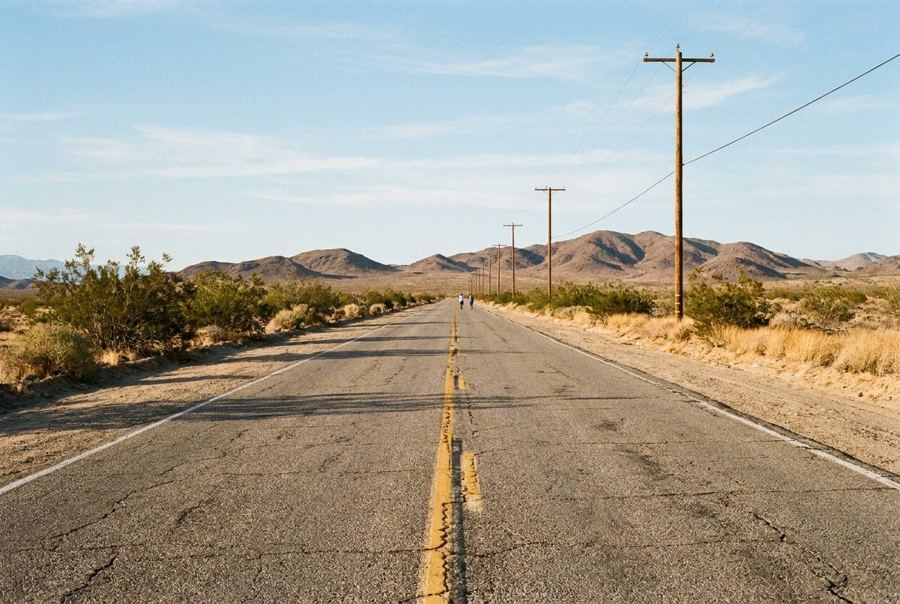 In town · worth the detourBefore the interstate, the road ran down Main Street
A railroad that changed hands
The Texas and Pacific kept its own name for most of a century. It became part of the larger Missouri Pacific system, and the Missouri Pacific in turn merged into the Union Pacific. The line through Van Horn is now part of the Union Pacific, and it remains one of the busiest freight routes in the Southwest, carrying traffic between the Gulf Coast, Texas and California.
The old company left traces across the state. Its main shops and offices were far to the east, and several towns along the line still honour the connection with museums, depots and displays. In East Texas a Texas and Pacific steam locomotive has been preserved and stands on display, a long way from the desert country it once served.
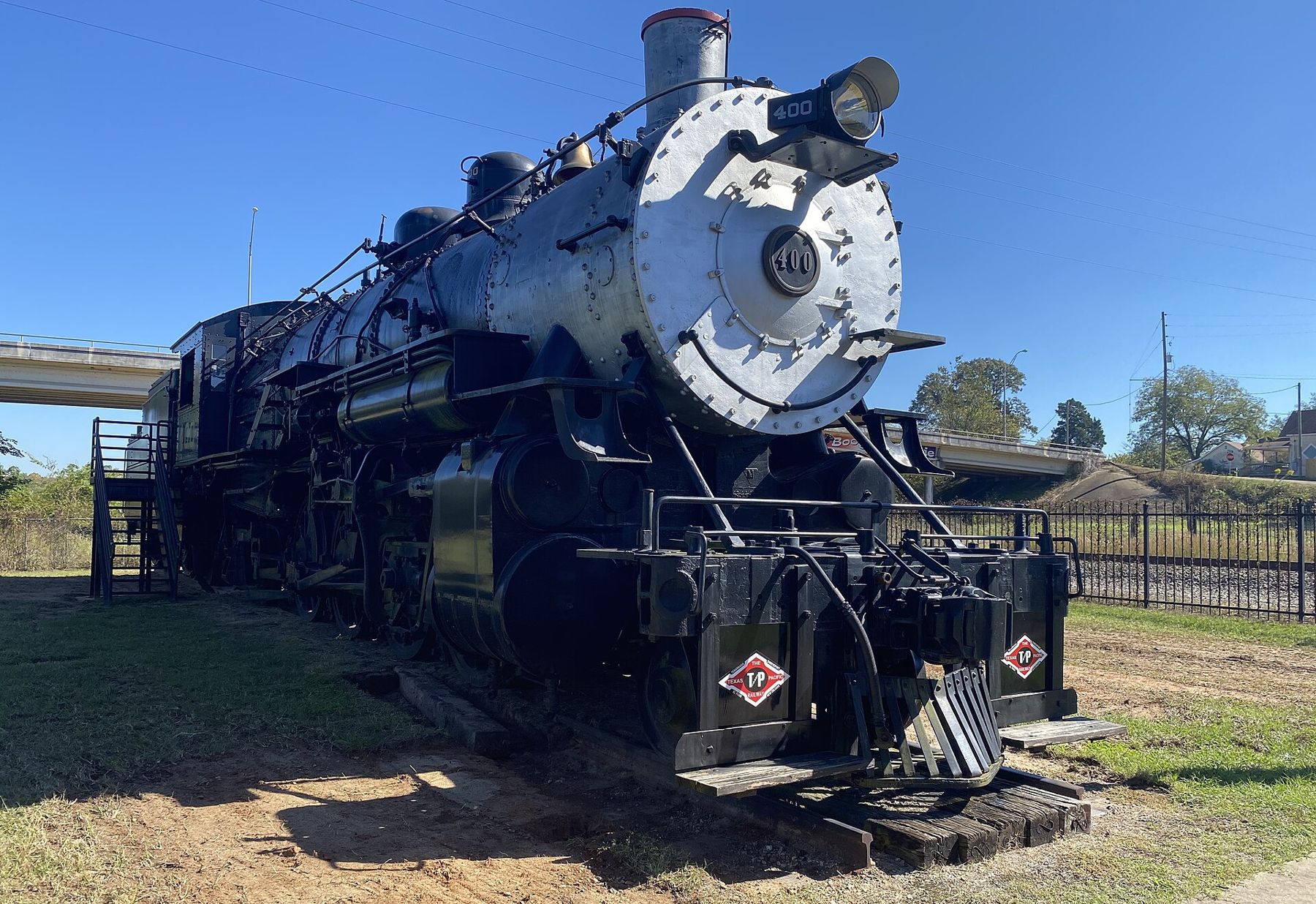
Out here the history is written less in museums than in the land: the straight line of the grade across a basin, an abandoned siding, an old water tank or the foundations of a vanished section house.
Watching trains today
In and around Van Horn, the railroad runs right beside the interstate, so you see trains whether you look for them or not. Freights can be more than a mile long, led by two or three locomotives, sometimes with more pushing at the back. You often see engines in the colours of more than one railroad on the same train.
- Find a public spot. Watch from a public road, a parking area or a pull-out with room to leave the highway safely. Never stand on the tracks or the railroad's land.
- Expect trains any time. There is no timetable for freight. Trains run day and night in both directions.
- Respect crossings. Many rural crossings have no gates. Stop, look both ways and never try to beat a train.
- Use the light. Early morning and late afternoon light is low and warm across the basins, with long shadows and mountains behind.
East of town, the line climbs and curves through broken country, and a train seen against the hills from a distance gives a sense of the scale. West of town, toward Sierra Blanca, it runs straight across flat basin, with the time zone line on the way, as our guide to the time-zone change explains.
Sierra Blanca and beyond
Sierra Blanca, where the two railroads met, is a small town today, the seat of Hudspeth County, with a historic courthouse and a quiet main street near the tracks. It sits about half an hour west of Van Horn on I-10, and the drive gives you a fair sense of the open, gently rising country the builders crossed. From there the line continues toward El Paso along the Rio Grande valley, past the old mission towns along the Mission Trail.
For travellers, the railroad is the thread that ties the region together. The towns, the highway and the grid of roads all follow it, and the trains still run past Van Horn much as they have since the early 1880s.
Back to the in town road · every distance from Van Horn · the crossroads